On November 6, vote NO in the METRO referendum. A no vote stops the diversion of METRO money away from transit projects.

Energy Corridor Alternative Transportation
Sunday, November 4, 2012
Wednesday, July 18, 2012
Monday, July 9, 2012
Reality check for H-GAC Bikeway Viewer
 Scope of comments:
State Highway 6 on the east, I-10 on the south, US290 on the north, and open to the west.
Bikeway needs (dotted purple):
I think most of dotted lines can be eliminated, because they describe suburban and rural roads that are already used by early Sunday morning recreational cyclists who share the roads with other vehicles. They are absolutely not commuting routes.
Proposed bikeways (dotted green):
I very much like Harris County's plan to put bikeways along bayous. Having said that, this points out another need... the need for N-S connectivity in places, even if the dotted green lines were built. We still need facilities where there are actual destinations, like on Eldridge, Highway 6, Queenston, Barker-Cypress, Fry, Greehouse, and the Grand Parkway area. These N-S routes could tie the bayou trails into a grid, which would be very useful for commuting, to help people get to work and school, not just for recreation. There are apartments along Highway 6, and also Barker-Cypress. These users need more infrastructure support than well-off recreational riders.
Please incorporate the H-GAC SH6 North Corridor Study bike-ped recommendations into the Bikeway Viewer.
Saturday, May 26, 2012
METRO can help with IAH-HOU controversy
The City of London has two international airports that I use frequently... Heathrow, and Gatwick. My office is very near Gatwick*, but I can get a non-stop from Houston only going to Heathrow. What to do for ground transport?
National Express runs a coach service between the two airports, with frequent departures (every few MINUTES), it's about an hour run. It's not cheap, it's 25 Pounds if you get a ticket at the last minute. Big beautiful clean coaches, seatbelts, nice.
Maybe METRO could approach Southwest and United and get them to fund a frequent IAH-to-HOU (Hobby) service, with the argument being that this will help each of them compete against the other, by making it easier for each of the to skim passengers off of the other's network and onto their own.
* My office is on the Gatwick grounds... I walk 8 minutes from the South terminal and walk into our lobby. It's very odd, but very convenient. The hotel is across the parking lot.

Saturday, May 12, 2012
METRO General Mobility Program
Here are some of my ideas concerning getting out of this METRO General Mobility Trap that we've gotten ourselves into, and that cities are so reticent to give up (actually, with good reason from their perspectives).
1. Still give the GMP 1/4 penny to cities, but require that it be spent only on truly TRANSIT READY COMPLETE STREETS.
2. The GMP grant would decrease linearly over 10 years. By 2024 it would be gone. That would give cities lots of time to gradually adjust to its disappearance.
3. METRO would have to spend what it gets back from cities by gradually rolling back the GMP locally in those very same cities subjected to the GMP claw-back, new routes, new facilities. The butter would have to be spread thinly and evenly over the toast, not piled into one area distant from those being taxed.
4. 74% of the METRO taxation area unserved would have to be decreased to 0% unserved by 2024 (well... a stretch goal to be sure).
Keywords: katy, bellaire, memorial villages, hedwig, bunker hill, houston, rebuild houston, METRO, George Greanias, Gilbert Garcia, copperfield, cy-fair, cypress, transit
1. Still give the GMP 1/4 penny to cities, but require that it be spent only on truly TRANSIT READY COMPLETE STREETS.
2. The GMP grant would decrease linearly over 10 years. By 2024 it would be gone. That would give cities lots of time to gradually adjust to its disappearance.
3. METRO would have to spend what it gets back from cities by gradually rolling back the GMP locally in those very same cities subjected to the GMP claw-back, new routes, new facilities. The butter would have to be spread thinly and evenly over the toast, not piled into one area distant from those being taxed.
4. 74% of the METRO taxation area unserved would have to be decreased to 0% unserved by 2024 (well... a stretch goal to be sure).
Keywords: katy, bellaire, memorial villages, hedwig, bunker hill, houston, rebuild houston, METRO, George Greanias, Gilbert Garcia, copperfield, cy-fair, cypress, transit
Monday, March 5, 2012
Bogota trip report: bicycling and walking
Having heard a great deal about transportation
improvements in Bogota, Colombia, I was eager to see them with my own
eyes. A business trip to the Colombian oil sector brought me there this
week. Here's what I observed.
Fifteen years ago, I remember it was semi-suicidal to cross the street as a pedestrian in Bogota. Also, I don't particularly remember seeing any bicycles there in the 1990s.
Now, there is an environment which is pedestrian friendlier. There are decent walk signals, drivers are much more respectful of walkers, and problem intersections are staffed with actual crossing guard officers whose only job is to protect pedetrians. Some streets have been closed off to motorized traffic, and are foot only. There are ped bridges which span some of the large boulevards (think freeways), so that people don't get run over and hit trying to cross. Some of these bridges are gigantic. Imagine a ped bridge over the Southwest Freeway. The difference from 1997 until today for the pedestrian is a night/day difference.
A similar story exists for bicycles. Now, the city is awash in bicycles, seemingly at about the same participation rate as Seattle. based on my eyeball assessment. Much is spoken about the Sunday "ciclovias" where they close off key boulvards to cars and form a ring route for bikes. Also, some has been written about bicycle paths (European style... seperated from the cars). What I haven't heard people discuss is the fact that there is a tremendous amount of cycling taking place on the old, unchanged street & road infrastructure, and I didn't observe anything in the way of Texas-style car/bike conflict ("get out of my way you a****le!"), and I was looking for it. The bicyclist behaviors are good; overall, helmet use is in the 30% range (higher for middle class riders, lower for working class). There is decent fraction of users who use bike lights at night, much more so than here in the Houston area.

{a roadway similar to Allen Parkway. Note wide walking paths on both sides. Bi-directional bike lane seen on the left. Passenger train running down the middle. Note dramatic pedestrian suspension bridge in the background}
In other words, there has been a strong and successful intervention concerning operator behaviors, for both motorized and non-motorized users, quite apart from the building of new infrastructure. The culture has changed, it has done a 180 degree turn. This is the point I made to Chelsea Young, the new H-GAC bike/ped coordinator, just prior to my Bogota trip. I expressed the opinion that the H-GAC bike/ped subcommittee spends too much time thinking about ways to get more funding to "build stuff" (When? 2040? I'll be 79 years old. With what money? All levels of government are broke), and not enough time trying to change behaviors to make life easier and safer for bicyclists and pedestrians today with the infrastructure we have. My sentiments are shared by John Forester, PE himself, the father of modern traffic cycling principles. Bogota proves that point. You can significantly move forward with the infrastructure you've got.
The TransMillenio true bus rapid transit (BRT) is a great success in Bogota. I say "true" because it has dedicated lanes taken away from cars (gasp) and sheltered platforms where customers pre-pay before boarding and the platform is level with the floor. METRO's HOV buses fails on both these points. The vehicles are the same config as the artiqs METRO used to run, but a different brand. When you see the bus after bus after bus coming down the guideway all day long, and every bus is full, and you see the scope of the TransMillenio coverage on the map, you can see what a hugely important asset this is to Bogota. If you took away the Trans with the shake of an evil magic wand, the city's economy would crumble. It would be like shutting down New York's subway or London's Tube. Taking away some car lanes and given them over to the BRT has resulted in a huge net increase in the number of people you can move across the metro area.
But car drivers do pay a price. There is no congestion tax, but you can only bring your car into the central city on certain days, based on your license plate number. If you look around, you see 2-3 people in each car at rush hour. People cooperate to get each other home; what a concept. There would be no way to have mostly single-occupant vehicles in Bogota. Again, the system would come to a halt.
Remember, Bogota is 7 million people with a density of 11,000 per square mile. Houston is 2 million at 3,450 per square mile. Bogotanos had no choice. They had make the choices they made more than 15 years ago in order to have a working city now. But let's also keep in mind, the per capita GDP in Colombia is $6,685, in the USA it's $48,147. Colombia is one-seventh as wealthy as the USA, per person. If they could make these changes, why can't we?
The upside is that with all of this walk- and bike-friendliness now Bogota is becoming a new trendy tourist location and bringing even more economic development to the city.
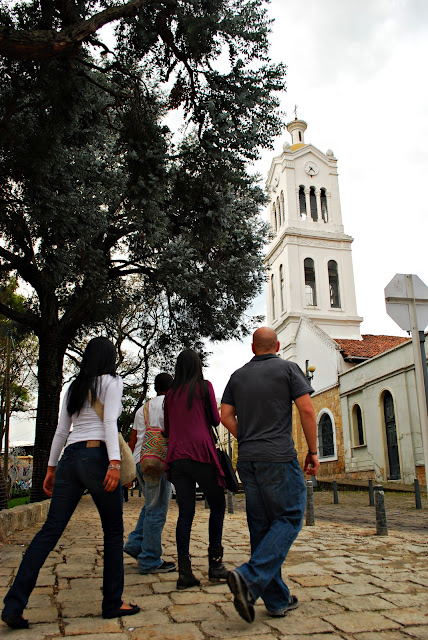
Tourists enjoying the Usaquen district of Bogota on foot. I enjoyed a delicious "parillada mixta" (mixed grill) and a Club Colombia extra-dry pilsner at a posh restaurant in Usaquen on 2 March 2012. Photo by Google+ User Loon Lio. Posted to the public Internet. More photos here.
Fifteen years ago, I remember it was semi-suicidal to cross the street as a pedestrian in Bogota. Also, I don't particularly remember seeing any bicycles there in the 1990s.
Now, there is an environment which is pedestrian friendlier. There are decent walk signals, drivers are much more respectful of walkers, and problem intersections are staffed with actual crossing guard officers whose only job is to protect pedetrians. Some streets have been closed off to motorized traffic, and are foot only. There are ped bridges which span some of the large boulevards (think freeways), so that people don't get run over and hit trying to cross. Some of these bridges are gigantic. Imagine a ped bridge over the Southwest Freeway. The difference from 1997 until today for the pedestrian is a night/day difference.
A similar story exists for bicycles. Now, the city is awash in bicycles, seemingly at about the same participation rate as Seattle. based on my eyeball assessment. Much is spoken about the Sunday "ciclovias" where they close off key boulvards to cars and form a ring route for bikes. Also, some has been written about bicycle paths (European style... seperated from the cars). What I haven't heard people discuss is the fact that there is a tremendous amount of cycling taking place on the old, unchanged street & road infrastructure, and I didn't observe anything in the way of Texas-style car/bike conflict ("get out of my way you a****le!"), and I was looking for it. The bicyclist behaviors are good; overall, helmet use is in the 30% range (higher for middle class riders, lower for working class). There is decent fraction of users who use bike lights at night, much more so than here in the Houston area.
{a roadway similar to Allen Parkway. Note wide walking paths on both sides. Bi-directional bike lane seen on the left. Passenger train running down the middle. Note dramatic pedestrian suspension bridge in the background}
In other words, there has been a strong and successful intervention concerning operator behaviors, for both motorized and non-motorized users, quite apart from the building of new infrastructure. The culture has changed, it has done a 180 degree turn. This is the point I made to Chelsea Young, the new H-GAC bike/ped coordinator, just prior to my Bogota trip. I expressed the opinion that the H-GAC bike/ped subcommittee spends too much time thinking about ways to get more funding to "build stuff" (When? 2040? I'll be 79 years old. With what money? All levels of government are broke), and not enough time trying to change behaviors to make life easier and safer for bicyclists and pedestrians today with the infrastructure we have. My sentiments are shared by John Forester, PE himself, the father of modern traffic cycling principles. Bogota proves that point. You can significantly move forward with the infrastructure you've got.
The TransMillenio true bus rapid transit (BRT) is a great success in Bogota. I say "true" because it has dedicated lanes taken away from cars (gasp) and sheltered platforms where customers pre-pay before boarding and the platform is level with the floor. METRO's HOV buses fails on both these points. The vehicles are the same config as the artiqs METRO used to run, but a different brand. When you see the bus after bus after bus coming down the guideway all day long, and every bus is full, and you see the scope of the TransMillenio coverage on the map, you can see what a hugely important asset this is to Bogota. If you took away the Trans with the shake of an evil magic wand, the city's economy would crumble. It would be like shutting down New York's subway or London's Tube. Taking away some car lanes and given them over to the BRT has resulted in a huge net increase in the number of people you can move across the metro area.
But car drivers do pay a price. There is no congestion tax, but you can only bring your car into the central city on certain days, based on your license plate number. If you look around, you see 2-3 people in each car at rush hour. People cooperate to get each other home; what a concept. There would be no way to have mostly single-occupant vehicles in Bogota. Again, the system would come to a halt.
Remember, Bogota is 7 million people with a density of 11,000 per square mile. Houston is 2 million at 3,450 per square mile. Bogotanos had no choice. They had make the choices they made more than 15 years ago in order to have a working city now. But let's also keep in mind, the per capita GDP in Colombia is $6,685, in the USA it's $48,147. Colombia is one-seventh as wealthy as the USA, per person. If they could make these changes, why can't we?
The upside is that with all of this walk- and bike-friendliness now Bogota is becoming a new trendy tourist location and bringing even more economic development to the city.
Tourists enjoying the Usaquen district of Bogota on foot. I enjoyed a delicious "parillada mixta" (mixed grill) and a Club Colombia extra-dry pilsner at a posh restaurant in Usaquen on 2 March 2012. Photo by Google+ User Loon Lio. Posted to the public Internet. More photos here.
Peter Wang, LCI
"Bicycles Make Everything Better"
"Bicycles Make Everything Better"
Saturday, February 18, 2012
Transportation choice is like salt
Politicians are not valuing
transportation choice. This has to change. Salt is a substance which is
not valued very much... you can buy a lot of it for little money. But if
you OMIT THE SALT from the $100 a plate gourmet meal, the meal is
wrecked. We're in the same situation in HGAC... many of us perceive that
our lives are "missing the salt", but the politicians don't get it.
It's highly instructive that people pushing for transportation choices often have lived in places in the past where there was transportation choice. People who have never left the sunbelt are less likely to be aware of the advantages.
It's highly instructive that people pushing for transportation choices often have lived in places in the past where there was transportation choice. People who have never left the sunbelt are less likely to be aware of the advantages.
Subscribe to:
Posts (Atom)